Why Getting to the Gym Is Harder Than the Workout When You Have ADHD
Quick Answer: For most people with ADHD, exercise isn’t blocked by motivation - it’s blocked by task initiation and the number of decisions between the couch and the first rep. Once you’re moving, the workout is usually fine or even great. The fix is reducing the decision count to near zero and building a single automatic starting cue, not finding more willpower.
You wanted to go. You had time. You even liked it last time. And you still didn’t go, and then felt terrible about not going. That gap is a specific, well-described phenomenon and it has specific workarounds.

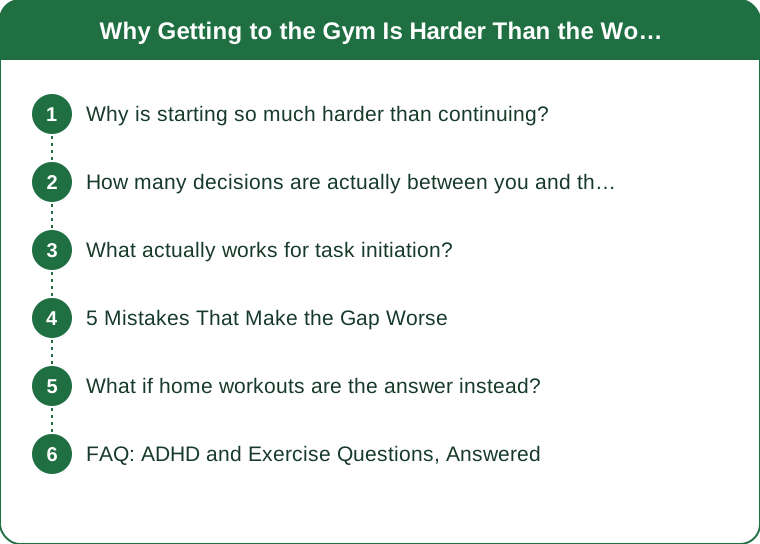
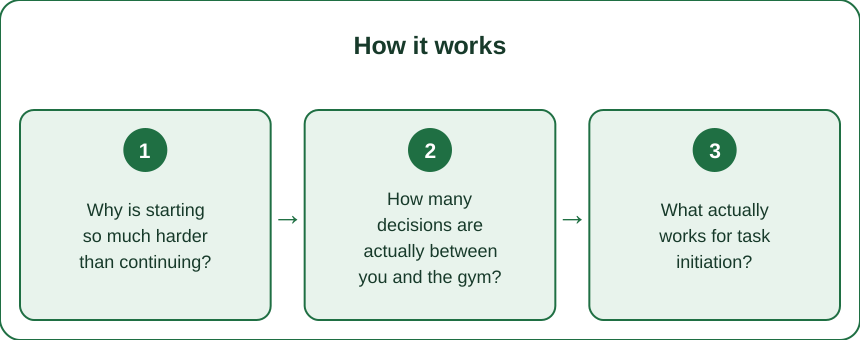
Why is starting so much harder than continuing?
Because they’re different tasks using different resources.
The workout itself is often genuinely well-suited to an ADHD brain: it’s immediate, physical, has clear feedback, and frequently produces hyperfocus. That’s why the middle of a session rarely feels hard.
The getting-there is a chain of small executive-function tasks with no reward attached to any of them. Find the leggings. Fill the bottle. Find the other shoe. Check the class time. Decide which route. Each one is minor. Stacked, they form exactly the kind of multi-step, low-stimulation sequence that ADHD makes disproportionately expensive.
The critical reframe: you are not failing at exercise. You are failing at a logistics chain that happens to end in exercise. Those need different solutions, and applying motivation strategies to a logistics problem is why the usual advice doesn’t work.
The secondary cost matters too - every failed attempt adds to a background of not-following-through, and that accumulated feeling makes the next attempt heavier than the last.
How many decisions are actually between you and the gym?
Count them once, honestly, and the problem usually becomes obvious.
A typical chain looks like: decide whether to go today, decide what time, decide which workout, find clothes, find shoes, find headphones, fill bottle, find keys, decide transport, decide what to do on arrival. That’s ten decisions before a single rep.
The goal is to get that number to two or fewer. Everything below is a method for deleting decisions rather than making them easier.
Delete by pre-deciding. Same days, same time, same session, written down once and not revisited. A schedule you don’t renegotiate is a schedule with zero daily decisions in it.
Delete by pre-staging. Bag packed the night before, in the doorway, not the bedroom. Clothes laid out. Bottle filled and in the fridge. This converts six decisions into zero.
Delete by removing options. One workout plan written on a card in the bag. Not an app with nine choices, not a plan you’ll pick from on arrival.
What actually works for task initiation?
Four things, and they’re all mechanical rather than motivational.
The five-minute rule, used honestly. Commit to arriving and doing five minutes with genuine permission to leave. Not as a trick - as a real option. Most people stay, but the rule only works if leaving is actually allowed, because your brain calls the bluff otherwise.
Body doubling. A friend, a class with a fixed start time, or even a video call with someone else exercising. External structure does the initiating that internal structure struggles with, and this is one of the most consistently reported ADHD-specific strategies.
Habit stacking onto something already automatic. Attach the gym to an existing anchor - straight after school drop-off, straight after finishing work, on the way home rather than back out from home. Going home first is the single most common failure point. Once you sit down, the chain restarts from a worse position.
Reduce the transition, not the workout. Change into workout clothes at the last automatic moment before the anchor event. Being already dressed removes the largest single friction point in the chain.

5 Mistakes That Make the Gap Worse
1. Choosing the optimal gym instead of the closest one. A better-equipped gym twenty minutes away loses to a mediocre one you pass on your existing route. Distance and route friction beat facility quality every single time for consistency.
2. Building a plan that needs a decision on arrival. Walking in and thinking about what to do is a fresh initiation problem at the worst moment. The plan should be written before you leave, and it should be the same for weeks at a time.
3. Using novelty as your motivation system. New app, new programme, new class - the novelty works brilliantly for about nine days and then stops. Novelty is best used as a scheduled tool, not a foundation. Change one variable every four to six weeks deliberately rather than chasing new when adherence dips.
4. Treating a missed session as evidence about yourself. The spiral after a missed week does more damage than the missed week does. A missed session is a data point about a logistics chain, not a verdict.
5. Making the sessions long. Ninety-minute plans are harder to start than thirty-minute ones by a large margin, and consistency at thirty minutes beats ambition at ninety. Shorten until starting is easy, then hold there.
What if home workouts are the answer instead?
Sometimes, and sometimes they’re a trap - the distinction is worth being clear about.
Home works when the equipment is permanently visible and set up, the session is short, and there’s a fixed time attached to an existing anchor. Visible equipment is the key variable; anything stored in a cupboard effectively doesn’t exist.
Home fails when it’s chosen to avoid the friction of leaving, because home has more competing stimuli than a gym does, no external structure, and no social cue. The friction you removed gets replaced by a harder distraction problem.
A useful compromise: use home for the days that would otherwise be zero, and keep at least one out-of-house session a week for the structure. Two gym sessions and two short home sessions beats an all-or-nothing plan in either direction.
And if executive function difficulties are seriously affecting your daily life beyond exercise, that’s worth discussing with a clinician - strategies help, but they aren’t a substitute for assessment or treatment. This is general information, not medical advice.
FAQ: ADHD and Exercise Questions, Answered
Is exercise actually helpful for ADHD symptoms?
Research generally supports exercise as beneficial for attention and mood, though it’s a support rather than a replacement for other treatment. The practical problem has never been whether it helps - it’s getting there.
Why can I hyperfocus on a workout but not start one?
Initiation and sustained engagement are different processes. Once the activity provides immediate feedback and stimulation, it holds attention well. Starting offers neither.
Should I work out at the same time every day?
If you can, yes - a fixed time removes a daily decision. But attach it to an event rather than a clock time where possible, since events are more reliable anchors than numbers.
What if I’ve quit five times already?
That’s typical and not diagnostic of anything about your character. Each restart is cheaper than the last if you keep the logistics fixes and change only the programme.
TL;DR:
- The barrier is task initiation and decision count, not motivation or willpower
- Count the decisions between you and the first rep, then delete them down to two
- Pre-stage everything the night before; never go home first
- Body doubling and fixed-start classes supply the structure that’s hard to generate internally
- Shorter sessions start more easily than long ones - consistency beats ambition
The workout was never the hard part. Fix the twenty minutes before it and the rest takes care of itself.
Keep Reading
This article is for general informational purposes only and is not medical advice. Always consult a qualified health professional for guidance specific to you.