The Gym Is Loud: ADHD Sensory Overload and the Fixes That Keep You Training
Quick Answer: Gyms stack every sensory stressor at once - unpredictable noise, fluorescent light, crowd movement, mirrors, and competing music - and an ADHD brain filters that load poorly, spending attention on suppression that was meant for training. The fixes are environmental, not motivational: over-ear headphones with one familiar playlist, off-peak hours, a pre-planned station sequence, and clothes with zero fabric annoyances. Change the room before you blame the routine.
You were not tired when you walked in. Forty minutes later you have done four exercises, checked your phone eleven times, and you leave feeling like you ran a marathon through a shopping mall. The workout was not the hard part.
Why does the gym drain you faster than the workout should?
Because filtering is work, and ADHD brains pay retail for it.
A commercial gym at 6pm is an unpredictability machine: plates dropped at random intervals, three music sources fighting, strangers crossing your peripheral vision, mirrors multiplying all of it, and a fluorescent flicker over the top. A neurotypical filter mutes most of that automatically. An ADHD filter processes far more of it manually, which spends the same limited executive-function budget the workout itself needs - for remembering the plan, counting reps, and resisting the phone.
The result is a session that costs double and delivers half:
- Rest periods stretch because re-focusing after each interruption takes real time
- The plan collapses into whatever machine is nearest, because decision-making is the first casualty
- You leave more depleted than the training justifies and mislabel it as being unfit or lazy
The usual advice - discipline, consistency, just go - misses the mechanism entirely. The limiting factor is not motivation, it is sensory load, and load is a property of the environment. Environments can be edited. That reframe matters, because it moves the fix from trying harder to changing four concrete inputs, most of which cost nothing.
Which senses are actually doing the damage?
Run a one-session audit instead of guessing. Note the moment your focus breaks and what broke it. The usual suspects:
Sound is the biggest offender. Not volume - unpredictability. A steady loud class is easier than random plate drops, and overheard conversation is the worst of all because language hooks attention automatically.
Light comes second. Fluorescent flicker and harsh brightness produce a low-grade agitation people rarely trace back to the ceiling. If you feel calmer the moment you leave, light was part of the bill.
Touch is the sneaky one. A waistband that needs hitching every set, a tag, a seam on the wrong spot, a bra strap that slides - each is a tiny recurring interrupt. For a brain that pays full price per interrupt, fabric matters more than it does for other people. Flat-seam, tag-free pieces and genuinely soft fabrics - the buttery-soft leggings category exists for a reason - remove a whole channel of noise. So does re-wearing the exact outfit that proved silent, on repeat, forever.
Visual motion. Mirrors and walkways put constant movement in your periphery, and peripheral motion is precisely what attention systems evolved to chase.
Social monitoring. The felt sense of being watched runs a background process that is expensive even when nobody is actually looking.
Most people discover one or two dominant channels, not all five - which is good news, because you only have to fix the loud ones.
What environmental fixes actually work?
In rough order of return on effort:
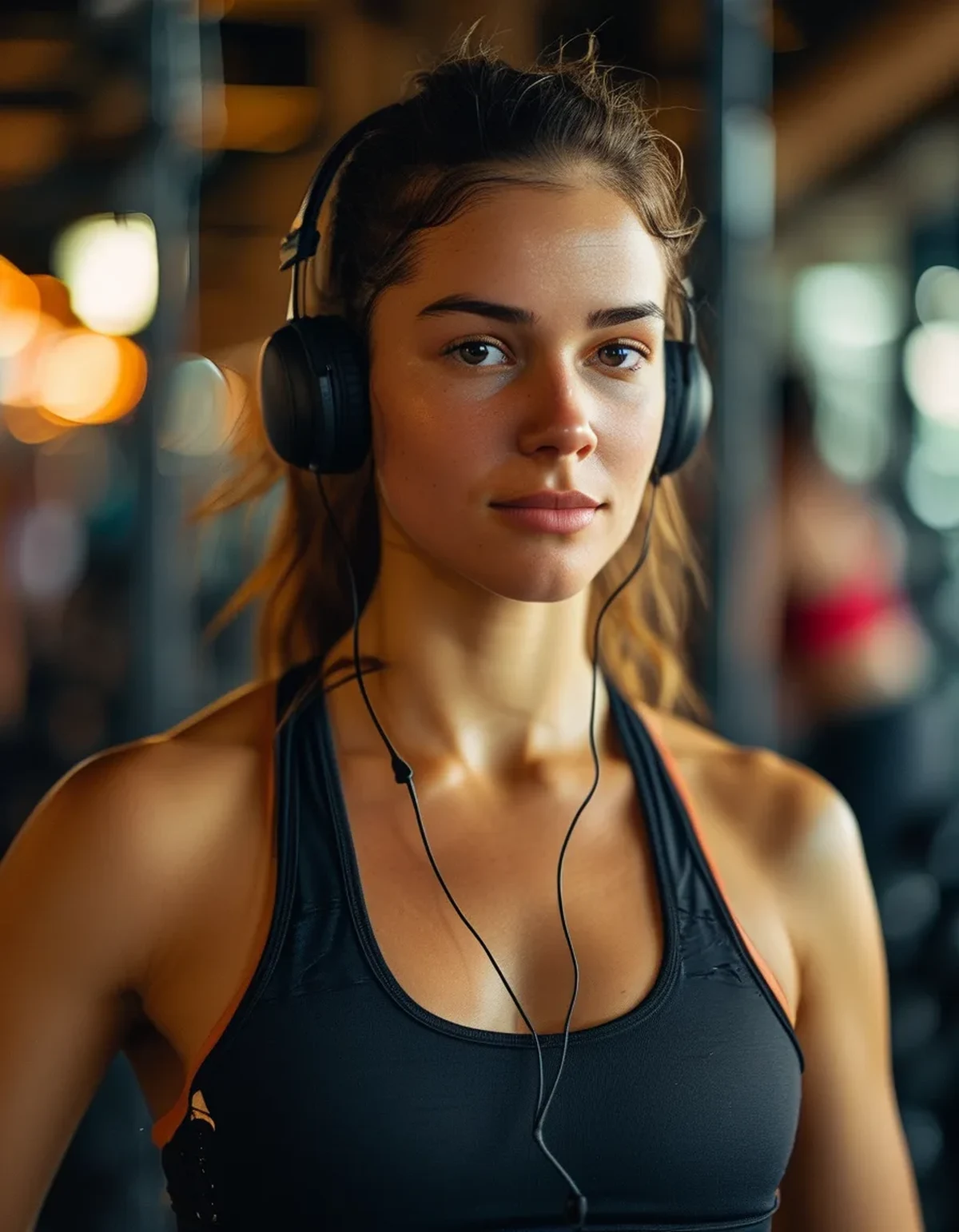
Over-ear headphones with one pre-built playlist. Over-ear beats earbuds for passive blocking, and the playlist must be decided at home - choosing songs mid-session is its own attention leak. Familiar music outperforms new music here; novelty is what you are trying to reduce. Some people do even better with brown noise or one album on loop.
Shift the clock, not the effort. The same gym at 6am, 11am, or 9pm is a different building. One off-peak session a week teaches you exactly how much of your struggle was the crowd.
Script the session before you enter. A written plan - five exercises, sets, order, plus a named backup for each station if it is taken - removes every in-gym decision. Deciding is the function the environment degrades first, so do all of it in a quiet kitchen.
Claim a corner. One dumbbell pair, one mat, one square of floor by a wall, back to the room. You have converted an open field into a booth, cut the visual channel, and removed walking-between-stations, which is where sessions go to die.
Cap the session honestly. Forty focused minutes beats ninety fragmented ones. Ending before the filter fails is what makes Thursday’s session feel possible.

What Nobody Tells You About Sensory Load and Training
Your worst gym days track your sleep, not your discipline. Sensory tolerance is not fixed - it shrinks with poor sleep, hunger, and a hard workday. The gym that was fine Tuesday and unbearable Thursday did not change. Your filter budget did, and scaling the session to the day is skill, not weakness.
Leaving early because of overload is not a failed session. Half a workout plus an intact relationship with the gym beats a completed workout that takes three days of avoidance to recover from. The metric that matters is whether you come back.
The overload often lands after, not during. Adrenaline masks the cost in the building; the crash, irritability, or fog shows up an hour later at home. If evenings after the gym are consistently bad, that is sensory data, not evidence that exercise disagrees with you.
Machines are underrated for exactly this reason. Free weights are technically superior and attentionally expensive - setup, spotting awareness, form monitoring. A machine circuit runs on rails, which some days is precisely the point.
Nobody is paying the attention to you that you are paying to them. The monitoring channel is real cost against imagined observation. Off-peak sessions quietly prove this, which is half of why they feel so much easier.
Sensory-friendly does not mean easy. You can train brutally hard in a quiet corner with headphones on. Reducing input is not reducing effort - it is routing the effort to the muscles instead of the filter.
When is home or outdoors the better answer?
When the math says so. The gym has equipment; home has silence, your own light, and zero strangers. For some ADHD brains the equipment does not repay the sensory tax, and pretending otherwise wastes months.
Home wins when: your dominant channels are social and auditory, your training is bodyweight or dumbbell-based anyway, and starting friction is your real enemy - nothing beats a kettlebell that lives next to the couch. A pair of adjustable dumbbells, a mat, and a band covers a genuinely effective program in six square feet.
Outdoors wins when: movement plus daylight noticeably regulates you - many people with ADHD find walking, rucking, or running outside actively organizing rather than depleting. Natural environments carry high sensory volume but low unpredictability of the annoying kind; birdsong does not hook attention the way overheard arguments do.
The gym still wins when: you need heavy barbells, classes give you body-doubling structure, or home is where your distractions live. Then apply every fix above rather than abandoning the building.
The honest test: run two weeks of each in your training log and score sessions completed and how you felt two hours after, not during. Completion rate is the only metric that compounds. A mediocre program you execute forty-five weeks a year beats an optimal one you dodge - and for sensory reasons, dodging was never a character flaw. It was the room.
FAQ: ADHD Gym Overwhelm Questions, Answered
Are loop earplugs or headphones better for the gym?
Different jobs. Filtering earplugs cut volume while keeping awareness, and they are better if headphones bother you physically or you need to hear a class. Over-ear headphones block more and add music. Plenty of people keep both in the bag and choose per day.
Is it weird to do the same workout in the same corner every time?
It is optimal. Novelty costs attention; repetition automates the session so your budget goes to effort instead of logistics. Progress comes from adding weight or reps, which requires zero novelty. Change the program every couple of months, not every session.
What about classes - better or worse for sensory load?
Both, depending on the class. High structure and one instruction source reduce decisions, which helps enormously; strobe-lit spin with layered music can be the most overloading room in the building. Try one calm-format class - strength-based, lower music - before writing off the category.
Do I just have to accept smaller workouts forever?
No. Tolerance is trainable at the edges - regular exposure at manageable doses, good sleep, and training in a regulated state all expand what you can handle. But the goal is a sustainable system, not toughness. If forty quiet minutes gets you training four days a week for years, that is not a compromise. That is the win.
TL;DR:
- The gym drains ADHD brains through filtering costs - sound, light, fabric, motion, and social monitoring - before the workout starts
- Audit one session to find your two loudest channels; most people do not have five
- Highest-return fixes: over-ear headphones with a pre-built playlist, off-peak hours, a written plan with backups, and a claimed corner
- Wear the outfit that proved silent on repeat - fabric interrupts are real attention costs
- Score home versus gym on sessions completed and how you feel two hours after; completion is the only compounding metric
The workout was never the thing defeating you at 6pm on a Tuesday. The room was. Edit the room - or the hour, or the building - and the discipline you supposedly lacked turns out to have been there the whole time.
Keep Reading
This article is for general informational purposes only and is not medical advice. Always consult a qualified health professional for guidance specific to you.