The ADHD Workout Fix That Has Nothing to Do With Motivation
Quick Answer: For ADHD brains, the barrier to a workout is usually the number of decisions between you and the first rep, not a lack of motivation. Cutting that decision count - by leaving clothes visible, pre-loading a single default workout, and removing every intermediate step - reliably works better than any motivation strategy, because it stops requiring the executive function that’s in short supply.
You want to work out. You planned to work out. It’s 4pm and you haven’t. That gap is not a motivation gap, and treating it like one is why every motivation strategy you’ve tried has failed by week three.

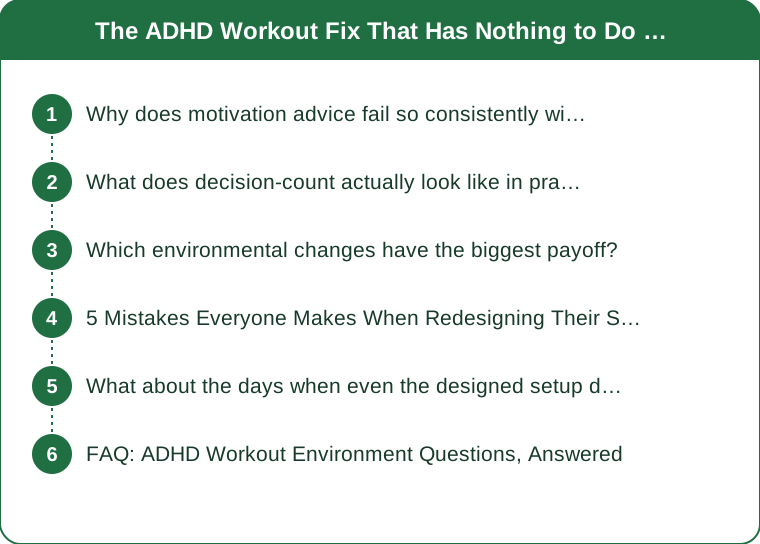
Why does motivation advice fail so consistently with ADHD?
Standard fitness advice assumes the hard part is wanting to. It builds elaborate systems around wanting: goal-setting, visualization, accountability, reward charts.
But ADHD-related difficulty with task initiation isn’t a wanting problem - it’s a transition problem. Moving from a current state into a different one requires executive function to sequence the steps, hold the plan, and override the pull of whatever you’re currently doing. Wanting it more doesn’t add executive function.
This is why the pattern is so specific and so frustrating: you can genuinely want the workout, know it will feel good, remember that it always feels good, and still not start. The desire was never the missing piece.
The reframe that actually helps: stop trying to increase motivation, and start decreasing the number of executive-function operations required to begin. Every decision you remove is one you don’t have to summon energy for.
What does decision-count actually look like in practice?
Count the steps between sitting on the couch and your first rep. Most home workouts have more than people realize:
- Decide whether to work out now or later
- Decide which workout
- Find the workout (app, video, saved plan)
- Find clothes
- Change
- Clear space
- Find equipment
- Start music or video
- Begin
Nine decisions, each one a potential exit point. On a low-executive-function day, you’re not going to clear nine gates.
Now compare a designed version:
- Clothes are already visible on the chair
- Today’s default workout is the same as every default workout
- Space is already clear, equipment already out
- Begin
Same person, same motivation, radically different odds. Nothing about the discipline changed - the gate count went from nine to four.
Which environmental changes have the biggest payoff?
Visible clothes. Not in a drawer, not in a closet - out, on a chair or hook, in your actual line of sight. Out-of-sight is functionally out-of-existence for a lot of ADHD brains, and this single change removes two steps (remembering, and finding).
One default workout, permanently. The single biggest decision drain is choosing what to do. Pick one 20-minute session and make it the default forever. Variety is something you can add on high-capacity days; it should never be a requirement on low ones.
Equipment left out. A resistance band draped over a door handle, a mat unrolled in the corner. Yes, it’s visually untidy. Tidy equipment that never gets used is worse than visible equipment that does.
Remove the changing step entirely on some days. Sleeping in workout-appropriate clothes on days you plan a morning session sounds ridiculous and works remarkably well - it deletes the highest-friction gate in the whole sequence.
The doorframe rule. Put the cue where the transition happens. Shoes at the door you actually leave from, not the door you theoretically should use.

5 Mistakes Everyone Makes When Redesigning Their Setup
1. Making the default workout too long. A 45-minute default is a decision disguised as a plan - you’ll assess whether you have 45 minutes, and that assessment is a gate. Make the default 15-20 minutes. Longer is always allowed; it just isn’t required.
2. Building a beautiful system instead of a visible one. Colour-coded plans in a well-organised app are invisible. A crumpled index card taped to the fridge is not. Visibility beats elegance every time.
3. Changing the setup every week. Novelty feels productive and destroys the automaticity you’re trying to build. Give a setup six weeks before changing anything.
4. Removing the cues once it starts working. Three good weeks feels like proof you’ve internalised it, so the clothes go back in the drawer - and the streak ends within days. The setup is the mechanism, not the training wheels.
5. Treating a missed day as evidence the system failed. The system isn’t supposed to produce a perfect record. It’s supposed to raise the floor on bad days. Judge it by whether bad weeks got better, not by whether every day was hit.
What about the days when even the designed setup doesn’t work?
It will still happen, and having a plan for it prevents the spiral where one missed day becomes a missed fortnight.
Have a genuine minimum. Not a scaled-back workout - a floor so low it’s absurd. Two minutes. One set. Putting the clothes on and doing nothing else. The purpose is preserving the identity and the cue association, not producing a training effect.
Separate the streak from the outcome. If the minimum counts as a completed day, the streak survives, and the psychological cost of a low day drops enormously.
Notice which days fail. If Thursday always fails, Thursday has a structural problem - a meeting that runs late, a commute, an energy trough - and no amount of environment design will fix a scheduling conflict. Move the session rather than fighting the day.
FAQ: ADHD Workout Environment Questions, Answered
Does this work if I go to a gym instead of training at home?
Yes, with different levers. The gate count for gym sessions is dominated by packing and travel, so a pre-packed bag that lives in the car and a fixed gym time remove the most steps.
Won’t having the same default workout forever get boring?
Probably, and that’s fine - boredom is a much easier problem to solve than not starting. Add variety on high-capacity days while keeping the default intact for low ones.
Is body doubling still useful if I do all of this?
Yes, and they stack well. Environment design lowers the gate count; body doubling adds an external structure that helps with sustaining once you’ve begun.
How long before this feels automatic?
Expect 6-10 weeks of consistent cue exposure before it feels less effortful. Keep the cues in place well past the point where you think you no longer need them.
TL;DR:
- The barrier is usually decision count, not motivation
- Count the steps between now and your first rep, then delete as many as possible
- Visible clothes, one permanent default workout, and equipment left out are the highest-payoff changes
- Keep the cues in place after it starts working - they’re the mechanism, not a crutch
- Have an absurdly low minimum so bad days don’t break the chain
Stop trying to want it more. Make it require less.
Keep Reading
This article is for general informational purposes only and is not medical advice. Always consult a qualified health professional for guidance specific to you.