The Workout Starts When You Pack the Bag, Not When You Arrive
Quick Answer: With ADHD, the barrier to training is usually task initiation, not effort tolerance - and every unmade decision between you and the door is another place to stall. Packing the bag and laying out clothes the night before removes six to ten micro-decisions from the moment your executive function is weakest. Treat the packing as the workout’s first rep, and count it as done.
You are not lazy and you are not lacking discipline. You have proved that by doing the hard session plenty of times. What breaks is the twenty minutes before it - the part with no dopamine in it at all.

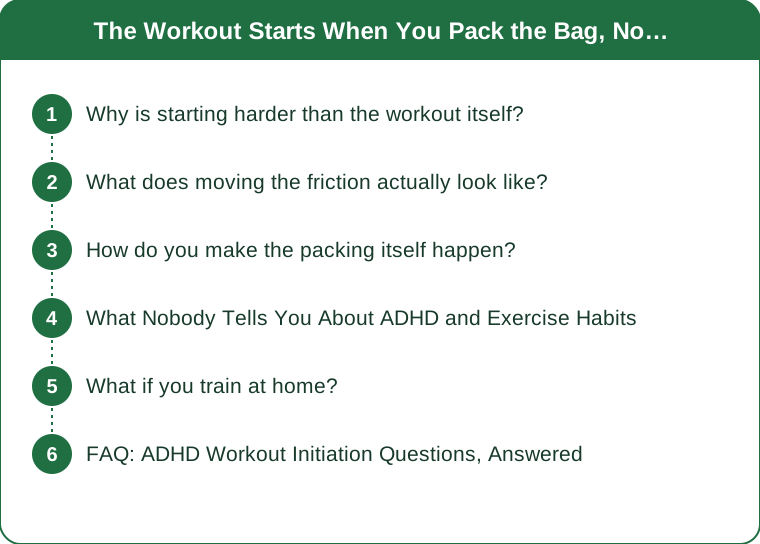
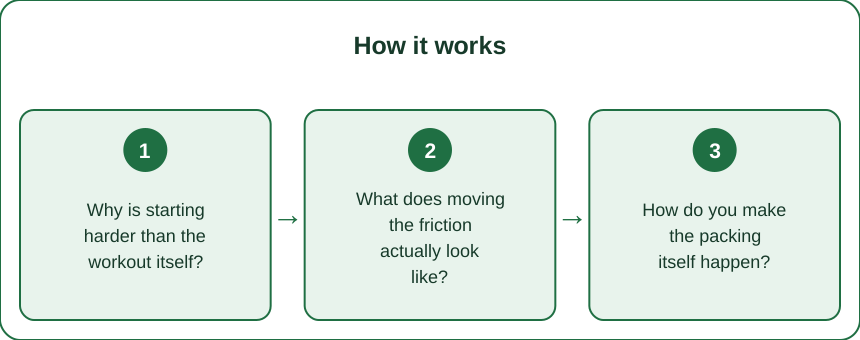
Why is starting harder than the workout itself?
Because starting is made of decisions, and decisions are the expensive resource.
A workout, once you are in it, is one continuous task with immediate feedback. That is a relatively ADHD-friendly shape. Getting there is the opposite shape: a chain of small, low-stimulation, sequential steps with no reward until the end.
Count the actual chain for a gym session: find leggings, find a clean bra, find socks, find the right shoes, fill the water bottle, find headphones, check they are charged, find keys, find the pass, decide the route, leave. That is eleven decisions, and any single one of them failing stops the whole chain.
This is why you can complete a brutal session on Tuesday and not leave the house on Thursday. Thursday was not a willpower failure. Thursday was headphones at 4 percent and no clean sports bra, at the exact moment your brain had nothing left for problem-solving.
The intervention is not motivation. It is decision removal.
What does moving the friction actually look like?
You do the eleven decisions at a time when they are cheap, and you leave nothing for the expensive moment.
Pack the night before, fully. Not partly. Bag packed, zipped, by the door. Clothes out, including socks and shoes. Bottle filled and in the fridge. Headphones on the charger.
Reduce the chain to two steps: get dressed, pick up bag. That is a chain short enough to survive a bad executive function day.
Keep a permanent duplicate kit. The single highest-value purchase for an ADHD training habit is a second set of headphones, a second water bottle, and a spare pair of socks that live in the bag permanently and never come out. Duplicates cost less than the sessions you lose to a missing item.
Put the bag where you physically have to move it. Not the cupboard. In front of the door, in the path to the car, on the seat you would otherwise sit down on. Object permanence is not a moral issue - out of sight genuinely is out of mind, so use the environment instead of your memory.
How do you make the packing itself happen?
Fair question, since packing is also a task and it can stall for exactly the same reasons.
Attach it to something already automatic. Immediately after you brush your teeth, immediately after you close the laptop, immediately after dinner plates go in the dishwasher. An existing habit is a free trigger; a reminder at 9pm is another decision.
Make it a two-minute job by keeping the list fixed. Same five items every time, in the same order, no thinking. If you find yourself deciding what to pack, the system has already failed - standardise it once and never revisit.
Pair it with something stimulating. Podcast, music, a phone call. Low-stimulation tasks are where ADHD brains stall; adding audio is not cheating, it is matching the task to the brain.
Do it badly rather than not at all. A bag packed with the wrong top still gets you to the gym. Waiting until you can pack it properly is how it ends up not happening.
And genuinely count it. The bag being by the door is a completed rep, and it deserves to feel like one.

What Nobody Tells You About ADHD and Exercise Habits
Consistency will not feel like consistency. Neurotypical habit advice assumes the behaviour gets easier and eventually automatic. For a lot of ADHD brains it stays effortful indefinitely, and the systems stay necessary forever. That is not failure to build the habit - the system is the habit.
Novelty is a legitimate tool, not a discipline problem. If the same session four weeks running stops working, rotate it. A varied plan you follow beats an optimal plan you abandon in week three.
The plan will collapse periodically and that is expected. Build for restart rather than for streaks. Streak-based apps and trackers can quietly become a reason to quit entirely after one missed day.
Body doubling works absurdly well and it does not require a person who trains with you. A friend on a video call doing their own thing, a busy class, or even a specific regular at the same time slot supplies enough external structure to carry the initiation.
The third one is the one that surprises people: most ADHD training failures are not in the session or the plan. They are in the twenty minutes before, and almost nobody designs for that window.
What if you train at home?
Home is easier in one way and much harder in another, so the setup needs to change.
Easier: there is no travel chain. Harder: there is no threshold, and the threshold is what makes the decision feel made. Home also has every competing stimulus in your life within arm’s reach.
What to build instead:
- A fixed physical setup, left out. Mat down, weights visible, the space already cleared. Packing away the equipment after each session reintroduces the entire setup chain you were trying to remove.
- A start ritual that is not the workout. Change clothes, put on the same playlist, fill the bottle. A three-step opener works as an artificial threshold.
- A single decided session, written down the night before. Open-ended home training means deciding what to do at the exact moment you are least able to decide.
- Phone in another room, on the charger. Not face down on the mat. In a different room.
Same principle throughout: decide in advance, remove the choice, use the environment rather than the memory.
FAQ: ADHD Workout Initiation Questions, Answered
Why can I do a hard workout but not start an easy one?
Difficulty is not the barrier - initiation is. A hard session often has more novelty and stimulation once underway, which makes it easier to stay in. The easy session offers less to hold attention, so it is easier to skip entirely.
Is it worth scheduling workouts at a fixed time?
Usually yes, but pair the time with a physical trigger rather than relying on a calendar alert. A notification is easy to dismiss; a packed bag blocking the door is not.
What do I do after missing a week?
Restart at a deliberately smaller version - one short session, no plan to rebuild the whole schedule. The barrier after a break is the size of the intended return, not the break itself.
Should I tell people I struggle to start?
If you can, yes - it turns an invisible problem into a shared one, and it is how you find a body-doubling partner. If ADHD is affecting daily function broadly, a professional assessment is worth pursuing. This is general information, not medical advice.
TL;DR:
- The barrier is task initiation, not effort - and initiation is made of small decisions
- Pack fully the night before and shrink the chain to get dressed, pick up bag
- Keep permanent duplicates in the bag so no item is ever a blocker
- Attach packing to an existing automatic habit and add audio to it
- At home, leave the setup out and decide the session in advance
Moving the work to the night before is not a trick to fool yourself. It is putting the demanding part of the task where your executive function is actually available. Pack the bag, count it as the first rep, and let the morning version of you do nothing harder than picking it up.
Keep Reading
This article is for general informational purposes only and is not medical advice. Always consult a qualified health professional for guidance specific to you.