Why Your ADHD Workout Routine Falls Apart on Weekends
Quick Answer: Weekday workouts run on borrowed structure - fixed wake times, commutes, and gaps between obligations. Weekends remove all of it, so the session has no anchor to attach to. The fix is to give the weekend its own external anchor rather than more willpower: a booked class, a person expecting you, or a time tied to something that already happens like coffee or the dog.
Five sessions a week, four of them Monday to Thursday. You do not decide to skip Saturday. It just gets to 4pm and the day has passed, and you cannot point to what took the time.

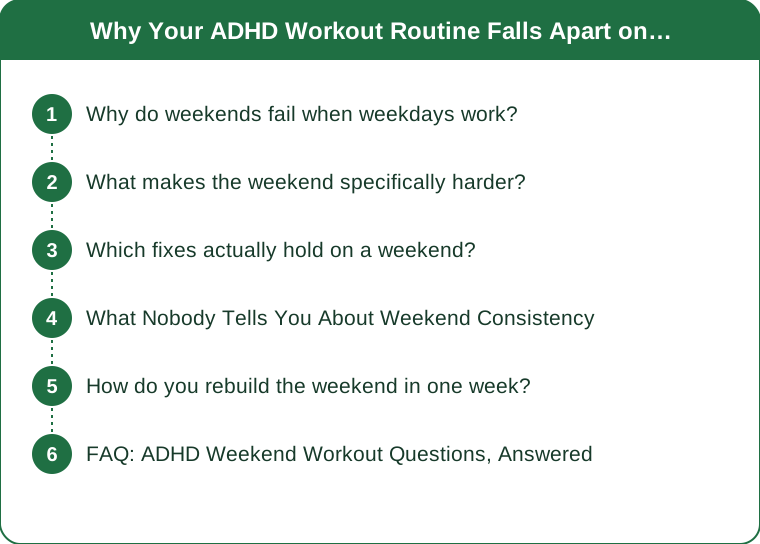
Why do weekends fail when weekdays work?
Because your weekday consistency probably is not coming from motivation at all. It is coming from structure you did not build and do not notice.
On a weekday, roughly this is happening: you wake at a fixed time because of work, you are already dressed and out of the house, there is a defined window between finishing work and dinner, and the day has hard edges. The workout slots into a groove that already exists.
Remove all of that and the session has nothing to attach to. A free day is not an easier day for an ADHD brain - it is a harder one, because an unstructured day requires you to generate the structure yourself, and that generation is exactly the executive function that is expensive for you.
This shows up in a very specific pattern:
- The session is never actively refused, it is deferred - later, after this, once I have eaten
- Time passes without a clear account of where it went
- You feel worse about it than you would about a deliberate rest day
- Monday is fine again, which makes the whole thing look like a discipline failure
It is not a discipline failure. It is a scaffolding gap, and scaffolding can be rebuilt deliberately.
What makes the weekend specifically harder?
Four things stack up, and knowing which ones apply to you decides which fix will work.
No time anchor. Weekday sessions usually sit against a fixed event - before work, after drop-off, during a lunch break. Saturday has no such fixture, so the window is theoretically all day, which functionally means no window at all.
Infinite runway. When something can be done at any point in the next fourteen hours, there is never a moment where it must happen now. Deadlines drive action; a fourteen-hour window has no deadline until it has expired.
Competing novelty. Weekends carry more interesting options than weekdays, and novelty is genuinely more rewarding to an ADHD brain than a familiar workout. You are not choosing badly, you are choosing the more stimulating thing, which is what the system is built to do.
Recovery debt. By Saturday you have spent five days masking, managing, and holding structure together. The tank is legitimately low, and some of what feels like avoidance is real fatigue that deserves a rest day rather than a fix.
That last one matters. If two weekend rest days would actually leave you training four times a week, that might just be your programme, and the problem is the guilt rather than the schedule.
Which fixes actually hold on a weekend?
The fixes that work all share one feature: the structure comes from outside you.
Book something with a start time. A class at 9:30 on Saturday is the single most reliable intervention there is, because it converts an open day into a fixture with a consequence for missing it. Paid or booked beats free and optional by a wide margin.
Attach it to something that already happens. You already make coffee, walk the dog, or take a child somewhere. Put the session immediately before or after that event and it inherits the anchor. This is habit stacking and it works precisely because it needs no new time decision.
Use a person. A friend expecting you at a specific place is external structure. So is body doubling - training alongside someone, in person or on a video call, doing entirely different things. The other person supplies the start signal you cannot reliably generate.
Shrink the ask and fix the time. A guaranteed twenty minutes at 9am beats a theoretical hour at some point. Short and scheduled survives; long and flexible does not.
Set the trigger the night before. Kit out, shoes by the door, bag packed. The Friday-night version of you has more executive function available than the Saturday-morning version, so let Friday make the decisions.

What Nobody Tells You About Weekend Consistency
Your weekday streak is evidence the system works, not that you have willpower. People conclude from a broken weekend that they lack discipline, when the accurate reading is that they built a good weekday system and no weekend system at all. That is a much easier problem.
Two different days need two different plans. Saturday and Sunday usually have different shapes - one social, one slower. Treating them as one interchangeable weekend block is why a plan that works on Saturday fails on Sunday.
Deferral feels like a decision but produces no memory. This is why the day genuinely seems to have vanished. Nothing was decided, so nothing was encoded. Writing the intended time down anywhere visible converts deferral into a choice you can actually notice yourself making.
Guilt is an active cost. A missed Saturday that generates two days of self-criticism reliably damages the following week more than the missed session itself did. Naming Saturday a planned rest day removes the whole cost at no fitness expense.
Novelty is a legitimate tool, not cheating. The workout that is boring on Wednesday can be replaced on Saturday by something you actually want to do - a hike, a swim, a class you have never tried. Weekend sessions do not have to resemble weekday sessions to count.
How do you rebuild the weekend in one week?
Pick one weekend day and give it exactly one anchor. Not both days, not a new programme.
Step 1 - choose the day with the most predictable shape. Whichever of Saturday or Sunday looks the same most weeks. Predictability is what an anchor needs.
Step 2 - name a specific time, in writing, tied to an existing event. Not morning. Right after the dog walk, or 9:30, or immediately after the first coffee.
Step 3 - make it external if you possibly can. Book the class, message the friend, set the video call. If none of that is available, use a public commitment - telling one person counts.
Step 4 - set the trigger on Friday. Clothes out, shoes visible, bag by the door. This step does more work than any amount of Saturday-morning resolve.
Step 5 - keep the other day genuinely free. Declare it a rest day out loud. A named rest day is not a missed session, and it stops the guilt from spilling into Monday.
Run that for three weekends before changing anything. If the anchored day holds and the free day feels fine, you have a five-session week and no weekend problem - which was probably always the actual goal rather than seven perfect days.
FAQ: ADHD Weekend Workout Questions, Answered
Is it a problem to just not train at weekends?
Not at all, if four or five weekday sessions meet your goals. Most general activity guidance is about weekly totals, not daily coverage. The problem is usually the guilt, not the gap.
Why does the same workout feel boring on Saturday and fine on Tuesday?
On Tuesday it is riding a groove and competing with nothing interesting. On Saturday it competes with genuinely more novel options. Swapping the weekend session for something novel is a valid fix rather than a compromise.
Morning or evening for weekend sessions?
Earlier, almost always. Weekend afternoons accumulate deferrals and social plans, and by evening the tank is low. Anchoring to the first predictable event of the day beats any later slot.
What if my weekends are genuinely unpredictable?
Then anchor to an event rather than a clock - after the first coffee, before the first meal out. Event anchors survive schedule chaos in a way that 9:30 does not.
TL;DR:
- Weekday consistency runs on borrowed structure from work and fixed obligations
- Weekends remove that scaffolding, so the session has nothing to attach to
- External anchors work: a booked class, a person expecting you, or an existing daily event
- Set the trigger on Friday night, when you have more executive function available
- Anchor one weekend day and declare the other a rest day to remove the guilt cost
The weekend gap is not a character flaw showing through on days off. It is the predictable result of a system that only exists Monday to Friday. Build one small piece of weekend scaffolding and the pattern usually breaks in a single week.
Keep Reading
This article is for general informational purposes only and is not medical advice. Always consult a qualified health professional for guidance specific to you.