The After-Work Workout Problem: Why the Transition Is the Hard Part
Quick Answer: The after-work workout usually fails during the transition, not during the workout. Shorten the gap between the last work task and the first physical action to under five minutes, remove every decision from that window by preparing the night before, and make the first action absurdly small - shoes on, out the door. Once movement starts, adherence is rarely the problem.
You meant to. You had the session planned. You sat down for four minutes to decompress and it is now 8:15pm and you are still on the sofa, mildly annoyed at yourself, and the window has closed.

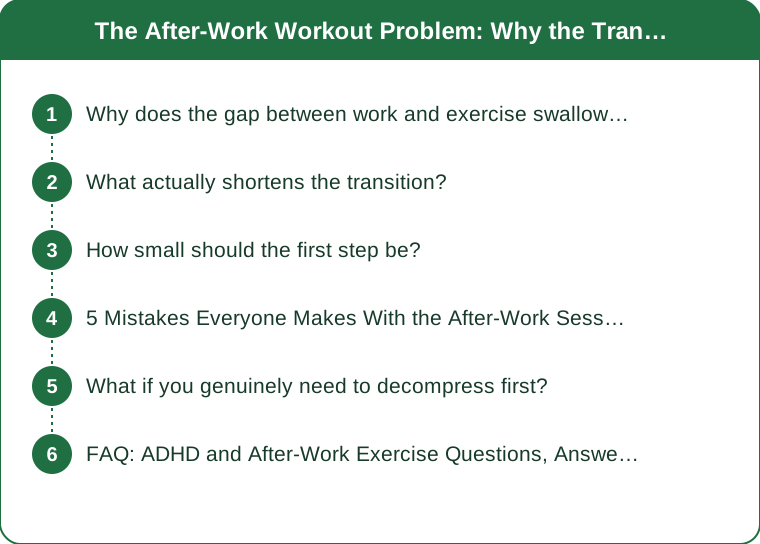
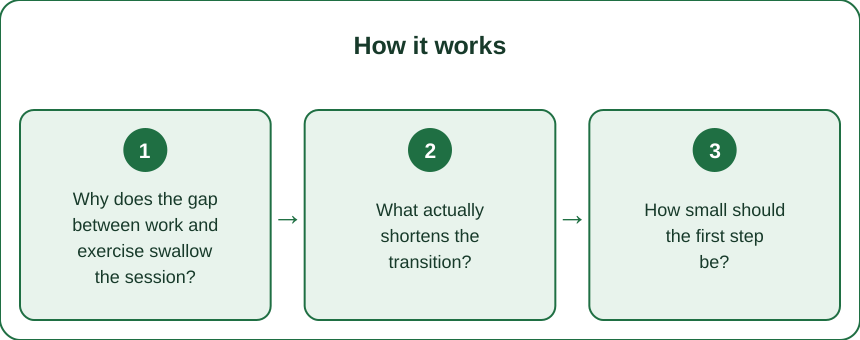
Why does the gap between work and exercise swallow the session?
Because that gap is a task switch, and task switching is precisely where ADHD executive function is most expensive.
Finishing work leaves you in a particular state: mentally used up, still holding fragments of unfinished tasks, and needing a reset. The reset is legitimate. The problem is that the default reset - sitting down with a phone - is a low-friction absorbing state. It has no natural end point, no external cue to stop, and it is genuinely more appealing than starting something effortful.
So the failure sequence is not I did not want to exercise. It is:
- Work ends, you need a buffer
- The buffer defaults to the most available low-effort thing
- That thing has no exit cue
- Time passes without registering
- The window closes and now there is guilt on top
Every part of that is a structural problem, not a willpower one. Which is good news, because structure can be redesigned and willpower cannot be summoned on demand at 6pm on a Thursday.
What actually shortens the transition?
Make the first physical action happen before the absorbing state starts, not after.
The under-five-minute rule. From closing your laptop to putting shoes on, aim for under five minutes. Not because five is magic, but because past roughly that point you have sat down, and standing back up is a second, harder decision.
Anchor to the end of work, not to a clock time. “At 6pm I will train” fails because 6pm arrives while you are mid-task. “When I close the laptop, shoes go on” works because it attaches to an event you cannot miss.
Get changed before the buffer, not after. This is the single highest-yield change most people make. Being in training clothes converts the sofa buffer from a session-killer into a genuine ten-minute rest, because you have already crossed the hard boundary.
Use a hard exit cue for the buffer. If you need twenty minutes to decompress, set an actual alarm with a sound you do not ignore, and put the phone across the room when you sit. A buffer with an end is restorative. A buffer without one is the whole evening.
How small should the first step be?
Smaller than feels reasonable. That is the point.
The goal at 6pm is not to start a workout. It is to make the entry action so trivially small that it does not require a decision:
- Put on shoes. That is it. Not “go for a run.”
- Walk to the end of the street and back.
- Unroll the mat. Sit on it.
- Do three minutes of anything.
This is not a trick to fool yourself into a full session, though that often happens. It is a genuinely lower bar, and the bar has to be low enough to clear on the worst day, not the average one. A plan calibrated to your good days fails four times a week.
Set a real floor. For a lot of people it is ten minutes of movement, done. If a session ends at ten minutes, it counts, fully, with no asterisk. The alternative - all-or-nothing at forty-five minutes - reliably produces zero on tired days and then a run of skipped days after, because the streak is broken and the identity goes with it.

5 Mistakes Everyone Makes With the After-Work Session
1. Planning by clock time instead of by event. Clock times require you to notice the clock, which is the exact executive function you are short on at the end of a work day. Event anchors do not.
2. Deciding what to do at the moment of doing it. Standing in a room at 6:15pm choosing between four options is a decision cost right at your lowest capacity. Decide on Sunday. Write it on a card. Follow the card without renegotiating.
3. Sitting down in work clothes. The change of clothes is the boundary. Every minute you spend on the sofa still dressed for work raises the cost of the switch.
4. Treating a shortened session as a failed one. This is the one that ends whole months. Ten minutes counts. The identity of someone who trains after work survives a short session and does not survive a skipped week.
5. Keeping the gym bag anywhere except by the door. Every extra location you have to visit before leaving is another chance for the sequence to break. Bag by the door, shoes next to it, keys on top of the bag.
The fourth one surprises people most - the sessions that keep the habit alive are usually the short ones you almost skipped.
What if you genuinely need to decompress first?
Then build the buffer deliberately instead of letting it happen to you, because an undesigned buffer expands to fill the evening.
A designed buffer has three properties: it is in training clothes, it has a set length with an audible end, and it is not on a phone with an infinite feed.
Options that reliably end on time:
- Ten minutes lying on the floor with music. Genuinely restorative, and standing up from the floor is easier than standing up from a sofa.
- A shower. Ends by itself. Works well if you train later in the evening.
- One specific episode or one album side. A defined length, unlike scrolling.
- A ten-minute walk as the buffer. This one converts the buffer into the session’s warm-up, and for many people it is the cleanest solution of all - the buffer and the entry action become the same thing.
Train earlier if you can. Lunchtime or straight-from-work-before-going-home both skip the transition entirely, because there is no absorbing state in between. When it is possible, this beats every technique above, since the best fix for a hard transition is not having one.
FAQ: ADHD and After-Work Exercise Questions, Answered
Why is it so much easier to train in the morning?
There is no absorbing state to escape from and no accumulated decision fatigue. Mornings are genuinely easier for many ADHD brains, and if it is available to you, taking it is not cheating.
Does body doubling help?
A lot, for many people. A class with a start time, a friend who is waiting, or even a video call with someone else training supplies the external structure that internal motivation is not reliably providing at 6pm.
Is it worth exercising if I only manage ten minutes?
Yes. Ten minutes of movement has real physical value, and more importantly it keeps the pattern alive so tomorrow is a continuation rather than a restart. Restarting is the expensive part.
Should I use stimulant timing to plan workouts?
Many people notice their medication timing affects when exercise feels accessible, and it is worth discussing with your prescriber rather than adjusting anything yourself. This is general information, not medical advice.
TL;DR:
- The session dies in the 20-minute transition, not in the workout itself
- Anchor to the event (laptop closes), not to a clock time you will not notice
- Change into training clothes before any buffer - this is the highest-yield single change
- Make the entry action trivially small and set a real floor of about ten minutes
- If you need to decompress, design the buffer with an audible end, or make a walk the buffer
Nothing here is about wanting it more. The people who train consistently after work have usually removed decisions from the 6pm window rather than found extra motivation for it. Redesign the twenty minutes and the workout mostly takes care of itself.
Keep Reading
This article is for general informational purposes only and is not medical advice. Always consult a qualified health professional for guidance specific to you.