Why Your Workout Plan Always Falls Apart Around Week 3 (ADHD Edition)
Quick Answer: Week 3 is when the novelty that made a new workout interesting wears off, and ADHD brains rely heavily on novelty-driven dopamine to stay engaged. The fix is building planned variation into the routine from day one, not forcing yourself through sameness with willpower.
Weeks 1 and 2 always feel great. New app, new class, new playlist — it’s genuinely fun. Then week 3 hits and suddenly getting to the gym feels like dragging a boulder, and it’s tempting to read that as a personal failure instead of a predictable pattern.

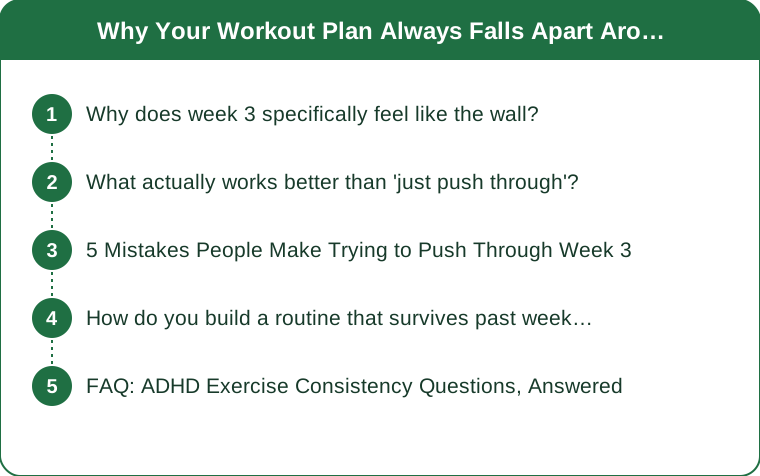
Why does week 3 specifically feel like the wall?
Because that’s roughly when a new activity stops being novel to an ADHD brain, and novelty is a major driver of dopamine-based motivation. The workout itself hasn’t changed — your brain’s chemical response to it has.
This isn’t a discipline gap. It’s a predictable neurological pattern, which is actually good news: predictable problems have predictable fixes.
What actually works better than ‘just push through’?
Build rotation into the plan from week 1, not as a rescue plan once boredom hits. Three different workout formats on a repeating cycle (say, strength / dance cardio / outdoor walk) keeps novelty renewing itself instead of running out.
The goal isn’t finding the One Perfect Workout — it’s accepting that variety is the sustainable structure for this particular brain.

5 Mistakes People Make Trying to Push Through Week 3
1. Doubling down on the same exact routine, assuming more willpower will fix what’s actually a novelty problem.
2. Quitting entirely instead of just switching formats — the goal was movement, not that one specific class.
3. Ignoring time-of-day mismatch. If week 1 energy was morning-driven and it’s now fading by week 3, your natural energy window may have shifted.
4. No accountability structure. Body doubling or a workout buddy re-injects social novelty when solo motivation dips.
5. All-or-nothing thinking. Missing 2 days doesn’t mean the plan failed — it means adjust, don’t abandon.
How do you build a routine that survives past week 3?
Plan for 3 rotating formats minimum, switch every 1-2 weeks proactively rather than waiting for boredom to force it, and keep a visible tracker — checking boxes provides a small dopamine hit that plain repetition doesn’t.
Treat week 3 as a scheduled ‘switch it up’ checkpoint on the calendar, not a crisis to react to after the fact.
FAQ: ADHD Exercise Consistency Questions, Answered
Is it normal to need a completely new workout every few weeks with ADHD?
Yes — many people with ADHD find that novelty-seeking is a consistent pattern, not a one-time phase, so planning for rotation long-term tends to work better than fighting it.
Does body doubling actually help with exercise specifically?
Many people report it helps significantly — having someone else present (in person or on a video call) adds external structure and social accountability that internal motivation alone often can’t sustain.
Should I feel bad about needing more variety than other people?
No — different brains are motivated differently, and building a plan around how yours actually works is more effective than forcing a structure designed for someone else’s brain chemistry.
TL;DR:
- Week 3 burnout is novelty wearing off, not a willpower failure
- Build 3+ rotating workout formats from day one instead of waiting for boredom
- Missing days doesn’t mean the plan failed — adjust the format, don’t quit
- Visible trackers and body doubling add the accountability novelty alone can’t sustain
The plan that survives isn’t the strictest one — it’s the one built to keep changing on purpose.
Keep Reading
This article is for general informational purposes only and is not medical advice. Always consult a qualified health professional for guidance specific to you.